
Body
Reflexology
Your feet contain a complete map of every organ system in your body. Pressed correctly, they can read it back to you.
There are over 7,000 nerve endings in each foot. The reflex arcs connecting them route to every major organ system in your body. The Egyptians knew it. The Chinese knew it. Eunice Ingham mapped it for the modern West in 1938. And yet most people still consider reflexology 'just a foot massage.' It is not a foot massage. It is a diagnostic and therapeutic system that happens to use the feet as the access point.
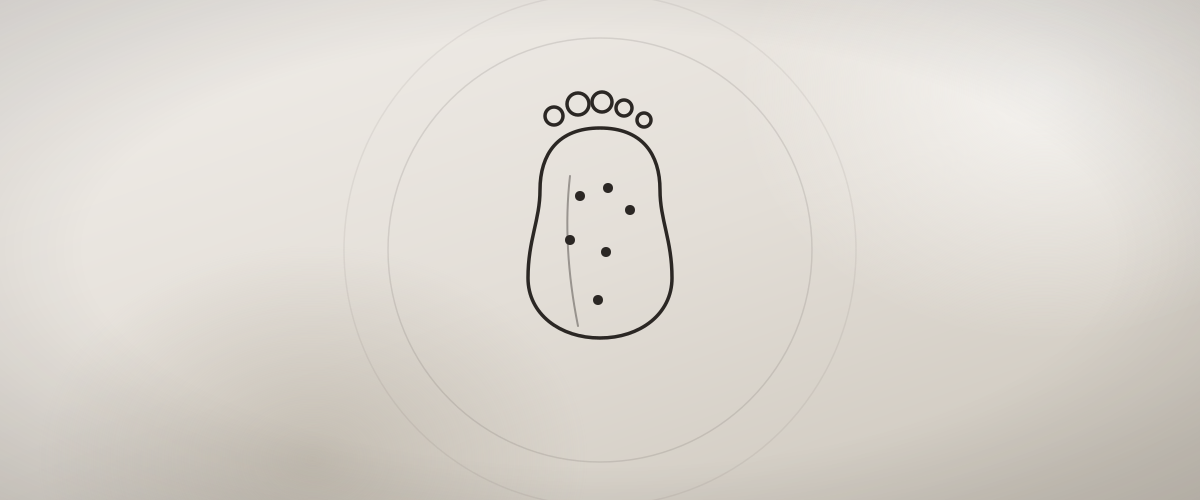
Egyptian tomb painting in Saqqara, ~2330 BCE, depicts foot work being performed on patients. Practiced in China, India, and indigenous cultures globally. The modern Western system was mapped by Eunice Ingham in the 1930s.
The oldest medical artwork in the world shows a reflexology session.
In 1979, archaeologists examining the tomb of Ankhmahor at Saqqara — physician to a 6th Dynasty Egyptian pharaoh, dated to roughly 2330 BCE — found a wall painting unlike any other in the tomb. It depicts two patients receiving simultaneous treatment on their hands and feet from two practitioners. Hieroglyphic captions read: 'Do not let it be painful.' 'I do as you please.' Specific foot reflex points are clearly marked.
Similar systems developed independently in China — the foot reflexology lineage that branched off from acupuncture meridian theory — and across the Indian subcontinent in Marma point traditions. The mapping is remarkably consistent across continents that had no contact. That convergence is itself evidence: humans across cultures observed the same correspondences between feet and organs because the correspondences are real.
How it actually works.
The traditional explanation is that energy channels (or in TCM, meridians) connect peripheral points to internal organs. The modern neurological explanation is mechanistically richer: the feet contain the densest concentration of proprioceptive and mechanoreceptor nerve endings in the body outside of the hands and face. These nerves connect via reflex arcs in the spinal cord to autonomic ganglia that regulate organ function.
- Pressure on specific reflex points stimulates the corresponding spinal segments and triggers parasympathetic responses in the mapped organ system.
- Microcirculation increases dramatically in the treated area and, via reflex pathways, in the corresponding organ.
- Lymphatic drainage in the lower extremities accelerates — important for anyone with chronic edema, post-surgical recovery, or sedentary work.
- Vagal tone improves measurably — sessions consistently produce drops in heart rate and blood pressure during and after.
- Reflexology has been documented to reduce pain perception via gate control mechanisms in the spinal cord — separate from but complementary to direct organ stimulation.
The clinical adoption
The UK's Macmillan Cancer Care integrates reflexology into oncology programs for symptom management. The NIH's National Center for Complementary and Integrative Health has funded multiple studies showing efficacy for cancer-related anxiety, pain, and fatigue. Maternity units in several European countries offer reflexology for labor support and postpartum recovery.
What people get wrong.
"Is this just a fancy foot rub?"
A foot rub feels good. Reflexology works specific points, in specific sequences, with specific pressures, against a detailed organ map. A skilled reflexologist can often identify physical issues you haven't mentioned by what they feel in the corresponding reflex zones. That is not a foot rub.
"Can it actually treat conditions?"
Reflexology is not a replacement for medical care for serious conditions. It is exceptionally effective as adjunctive therapy — supporting recovery, regulating stress, easing symptoms, improving sleep, and accelerating healing across a wide range of presentations.
"Will it hurt?"
Pressure on a tender reflex point can be intense — often signaling stress in the corresponding organ system. A trained reflexologist works to your tolerance and uses tender points as both diagnostic information and therapeutic targets. Discomfort is brief; relief tends to be lasting.
"The feet are the foundation of the body. Treat them, and you treat everything they support."
— Eunice Ingham, founder of modern reflexology
If you spend 16 hours a day on these two structures, an hour of skilled work on them is the most leveraged investment you can make.
What it works for.
- Stress and anxiety regulation
- Sleep disorders and insomnia
- Hormonal imbalance — menstrual, perimenopause, fertility
- Digestive complaints
- Headaches and migraines
- Lymphatic stagnation and edema
- Cancer-related symptom support (nausea, anxiety, fatigue)
What to expect at a first session.
Intake (10–15 min)
Health history, current symptoms, areas of concern. The reflexologist will explain the foot map and what they're going to do.
Session (45–55 min)
Fully clothed, shoes and socks off, reclined in a chair or on a table. The practitioner works systematically through both feet — sometimes including hands or ears — pressing, holding, and rotating reflex points. You'll likely identify tender areas; these often correspond to systems under stress.
After
A glass of water, a few minutes to ground. Effects on sleep, digestion, and energy often appear that same evening or next day. Most people benefit from a series — typically weekly for 4–6 sessions, then monthly maintenance.
How to choose a practitioner
Look for ARCB-certified reflexologists (American Reflexology Certification Board) or graduates of recognized 200+ hour programs. Many LMTs add reflexology certification. Every practitioner on Healforce is credential-verified before listing.